
Key points
- Advice shows how often to choose each action instead of prescribing only one.
- It narrows the opponent's range using only visible information, then compares equity and expected value.
- ○△× rates the selected action, not whether the hand wins or loses.
This article explains how BlackPoker generates its advice. It does not present fixed rules for poker in general. The figures may change as the game is adjusted (values as of October 28, 2026).
01Why It Does Not Choose Just One Action
In poker, you may mix your actions in the same spot. Sometimes you check a strong hand. Sometimes you bet with no made hand.
That is why the advice shows what to choose when the same spot is repeated many times. It tells you how often to fold, call, or raise. It does not mean you should always choose the action with the highest percentage.
Even after choosing a good action, you can lose because of the cards dealt that time. Whether you won or lost does not determine the quality of your choice.
02From Visible Information to Action Frequencies
The calculation uses only information visible to you at that point.
- 1
Visible information
Your 2 cards, the board, position, bet amounts, and the opponents’ actions so far.
- 2
Opponent’s range
Keep the hands consistent with the actions so far.
- 3
Calculation
Deal from the remaining range to estimate win odds, then compare the expected value of each action.
- 4
Action frequency
Choose higher-value actions more often.
To learn how the opponent’s range is narrowed, see Reading Ranges.
Postflop Calculations
Postflop, the game estimates win odds by running about 600 deals using the opponent’s range and the remaining cards. The win odds include your share from ties.
It then compares the expected value of checking, betting 40%, 70%, or 105% of the pot, calling, and raising. For bets, it also accounts for the chance that every opponent folds.
Only within the expected-value comparison, win odds are multiplied by 0.95 when you act later and by 0.86 when you act first. These multipliers are not used on the river. They are also not applied to the win odds shown on the screen.
Preflop Calculations
Preflop, the 169 starting hands are ranked by their win odds against one random hand. “Top X%” is counted using all 1,326 combinations with suits distinguished, not just the hand categories. The game compares your hand with the range played in that spot and calculates the frequency of each action. Hands very close to a cutoff are split between actions.
The cutoffs that change with position and the actions before you are covered in Starting Hands.
03Numbers Shown on the Screen
| Number | Meaning |
|---|---|
| Win odds (bottom left of the table) | An estimate from about 4,000 deals, assuming the opponent could have any cards. Includes your share from ties |
| Win odds based on the opponent’s actions | An estimate from about 600 deals after narrowing the opponent’s range using their actions so far. Shown postflop |
| Win odds needed to call | Call amount ÷ total pot after the call |
| Action frequency | How often to fold, call, or raise in the same spot |
For example, if the win odds based on the opponent’s actions are 39% and the win odds needed to call are 33%, you are above the required threshold if you can reach showdown without paying more. However, the possibility of another bet from your opponent and the remaining stacks also affect the decision. See Pot Odds and Expected Value for details.
04What ○△× Means
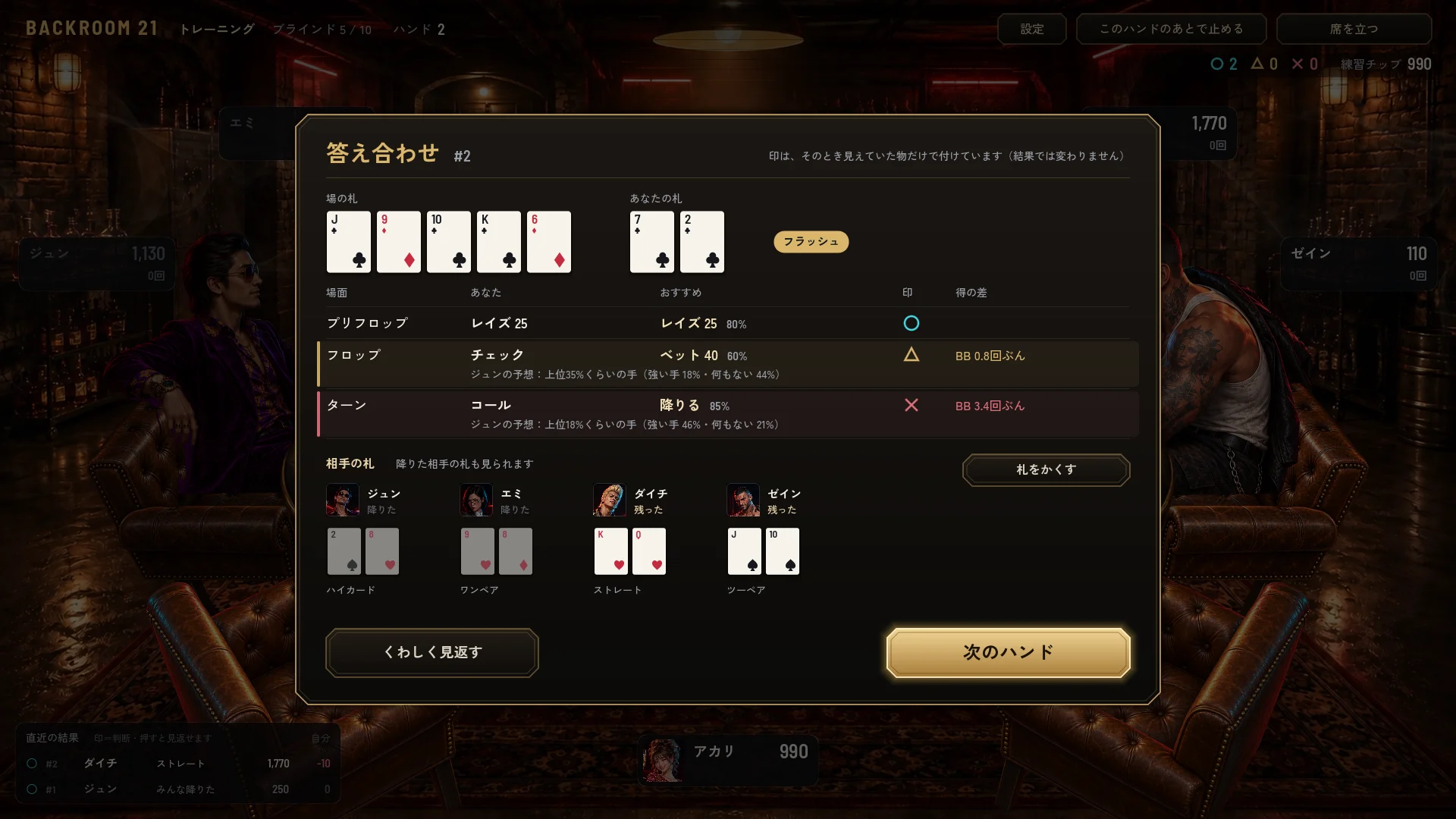
○△× does not show whether you won that hand. It compares the action you chose with the advice.
| Mark | When It Appears |
|---|---|
| ○ | The most frequently chosen action, an action chosen at least 30% of the time, or an action within 1/4BB of the highest-value action |
| × | An action that is never chosen and is at least 2BB below the highest-value action |
| △ | Anything between ○ and × |
- Differences in value are used only postflop. Preflop uses frequencies alone, and an action that is never chosen receives ×.
- The mark does not change between bet sizes of 40%, 70%, and 105% of the pot.
- An action with a low frequency can still receive ○ or △ if the difference in value is small.
05What It Does Not Cover
- This is not a solver, a tool that calculates strategies under set conditions while accounting for an opponent’s responses. It follows one skilled player’s approach and performs calculations based on it.
- It does not use ICM, which estimates tournament prize value from stack sizes and the prize structure. It uses the same approach as a ring game, with advice based on the stacks and the spot.
- Win odds are estimated by simulating deals, so the result may vary by 1–2% in the same spot. Do not treat a small difference as a large one.
- Opponents’ cards shown on the Check your answer screen were not used in the earlier calculation.
The calculation method and specific figures may change as the game is adjusted.
06Check Your Understanding with 3 Questions
Question 1Does the advice use the opponent’s actual hole cards in its calculation?
View answer
It uses only information visible to you, such as your cards, the board, position, bet amounts, and the actions so far.
Question 2You chose an action marked ○. What does that mean?
View answer
○ does not predict the result. It rates the choice when it was made, so you can still lose that hand.
Question 3The win odds in the same spot differ from before by 1%. What could explain this?
View answer
Because the number of deals is limited, the win odds can vary by 1–2% in the same spot.
07Try It in BlackPoker
In Training, you can choose whether to view Advice first or Think first. Each action receives a ○△× mark and a short comment. On ×, the game pauses and explains why. After the hand, any hand containing a △ or × can be reviewed on the Check your answer screen.
Frequently asked questions
Does Advice look at the opponent's cards?
No. It uses only information visible to you.
Does a ○ mean you will win the hand?
It is not a win-or-lose mark. You can still lose after an action marked ○.
Why does the equity change slightly in the same situation?
It is estimated by repeatedly dealing and counting outcomes. The same situation can vary by 1–2%.
Produced and edited by Predy GamesPublished:Updated:Report an error:Contact
Use Advice in BlackPokerBlackPoker is a single-player Texas Hold'em game played without real-money wagering. You can choose to view Advice first or think for yourself first. On ×, play pauses and shows the reason.
Go to BlackPoker