
Hand rankings
Hands higher on the list are stronger. Cards with gold borders make up the hand.
Learn how ties between the same hand rank are decided- 1Royal flush10, J, Q, K and A of the same suitA♠︎♠︎K♠︎♠︎Q♠︎♠︎J♠︎♠︎10♠︎♠︎0.003%
- 2Straight flushFive consecutive cards of the same suit9♥︎♥︎8♥︎♥︎7♥︎♥︎6♥︎♥︎5♥︎♥︎0.03%
- 3Four of a kindFour cards of the same rankQ♠︎♠︎Q♥︎♥︎Q♦︎♦︎Q♣︎♣︎7♠︎♠︎0.17%
- 4Full houseThree cards of one rank and two of anotherK♠︎♠︎K♥︎♥︎K♦︎♦︎4♣︎♣︎4♠︎♠︎2.6%
- 5FlushFive cards of the same suitA♦︎♦︎J♦︎♦︎8♦︎♦︎6♦︎♦︎2♦︎♦︎3.0%
- 6StraightFive consecutive ranks10♣︎♣︎9♦︎♦︎8♠︎♠︎7♥︎♥︎6♣︎♣︎4.6%
- 7Three of a kindThree cards of the same rank7♠︎♠︎7♥︎♥︎7♦︎♦︎K♣︎♣︎2♠︎♠︎4.8%
- 8Two pairTwo pairs of cards with matching ranksJ♠︎♠︎J♥︎♥︎5♦︎♦︎5♣︎♣︎A♠︎♠︎23.5%
- 9One pairTwo cards of the same rank10♥︎♥︎10♣︎♣︎A♠︎♠︎8♦︎♦︎4♣︎♣︎43.8%
- 10High cardNo made handA♣︎♣︎Q♦︎♦︎9♠︎♠︎6♥︎♥︎3♣︎♣︎17.4%
The frequency is the chance of making that hand from two hole cards and five board cards.
- SB · BB01BlindsTwo players post fixed amounts first
- 02PreflopDeal two hole cards to each player. First betting round
- K♠︎♠︎9♦︎♦︎7♣︎♣︎03FlopThree cards on the board. Second betting round
- K♠︎♠︎9♦︎♦︎7♣︎♣︎4♥︎♥︎04TurnFourth card on the board. Third betting round
- K♠︎♠︎9♦︎♦︎7♣︎♣︎4♥︎♥︎2♠︎♠︎05RiverFifth card on the board. Final betting round
- Showdown06ShowdownThe remaining players reveal their hole cards, and the strongest hand wins
Gold borders mark the board cards dealt in that round. If everyone but one player folds during betting, the remaining player wins.
Contents
6 categories and 16 articles.
 01New to poker4 articles · About 33 minGo to category →
Rules and hand rankings. Start here to learn how a hand plays out.
 02Basic strategy2 articles · About 13 minGo to category →
Which starting hands to play and how position changes your range.
 03Probabilities and numbers2 articles · About 15 minGo to category →
How often you hit your outs and how to evaluate a call.
 04Decisions by street3 articles · About 21 minGo to category →
How to act postflop and how much to bet.
 05Hand reading and bluffing2 articles · About 14 minGo to category →
Narrow the opponent's remaining hands from their betting.
 06Practice and references3 articles · About 23 minGo to category →
Test yourself with situational questions. Use the quick-reference chart and learn what the game's figures mean.
Not sure where to start?
Choose from three reading paths.
- 01
New to poker
Rules → Hand rankings → Comparing hands → Terms
Start with the rules - 02
I know the rules and want to learn strategy
Starting hands → Position → Postflop
Start with starting hands - 03
I want to use probabilities and numbers
Probabilities → Pot odds → Bet sizing
Start with the probability chart
Try one question
Each article ends with a question like this. Select an answer to see whether you got it and view the answer diagram.
1 questionWho wins?
View answer
Both players have two pair. Their higher pair is the same, K, but the lower pairs are 9 and Q, so Player B wins. Player A's A does not come into play.
Use at the table
Common figures are listed in the chart. Use the calculator below for other figures.
| Outs | Next card | By the river |
|---|---|---|
| 4 outs | 8.5% | 16.5% |
| 8 outs | 17.0% | 31.5% |
| 9 outs | 19.1% | 35.0% |
| 15 outs | 31.9% | 54.1% |
9 outs is the usual count when you are one card short of a flush.
| Opponent's bet as a share of the pot | Required equity |
|---|---|
| One-third | 20.0% |
| Half | 25.0% |
| Two-thirds | 28.6% |
| Same amount | 33.3% |
If your estimated equity is higher than this figure, the call has positive expected value over repeated situations.
Calculate figures not listed in the chart
Example: If an opponent bets 50 into a pot of 100, the pot becomes 150 and the call costs 50. If your estimated equity is higher than the required equity, the call has positive expected value over repeated situations.
These figures assume that after the three-card flop, you draw from the 47 unseen cards. 9 outs is the usual count when you are one card short of a flush. Hitting an out does not necessarily win the hand, because an opponent may make a stronger hand.
BlackPoker
Put what you learned into practice
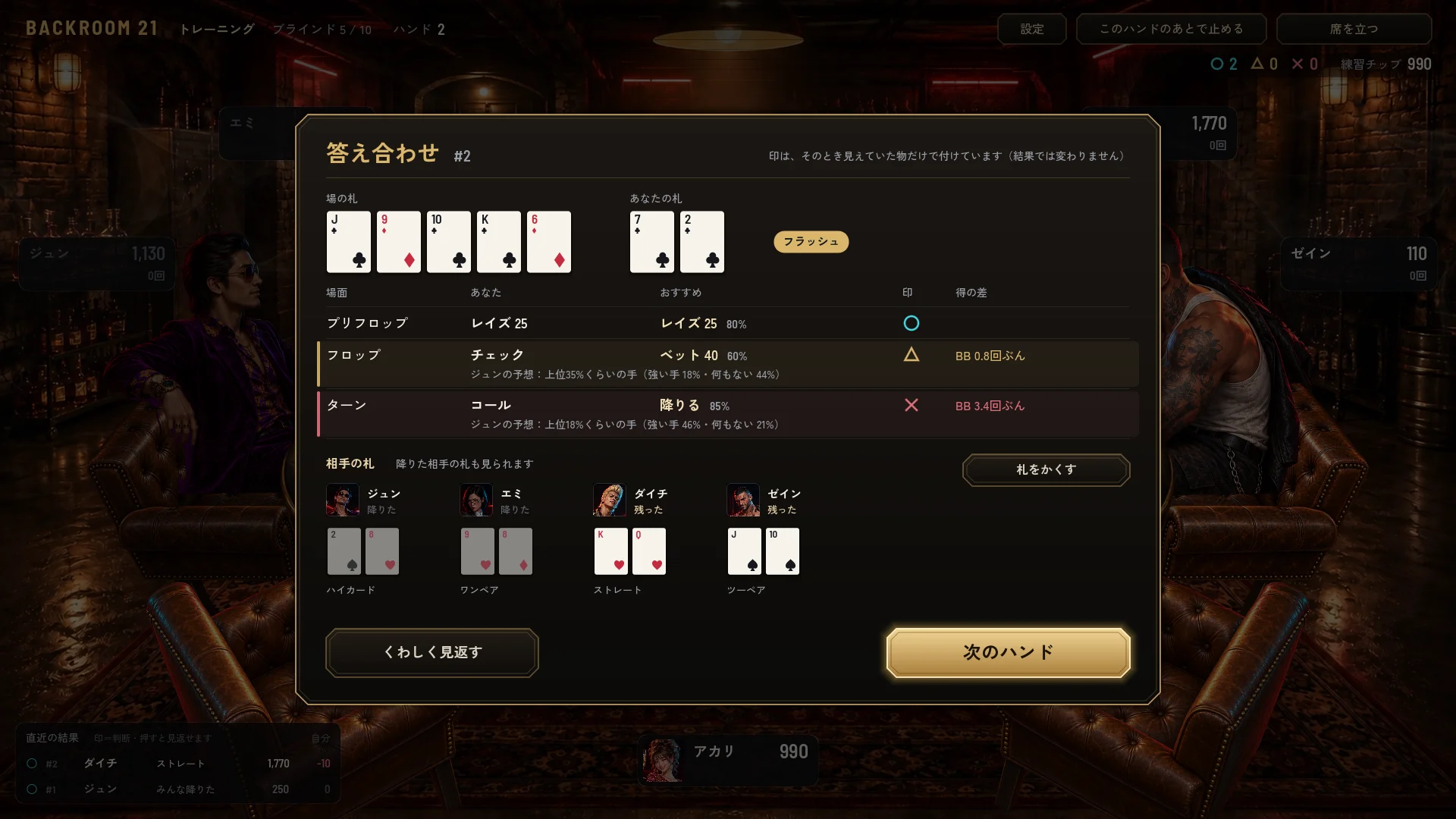
BlackPoker is a single-player Texas Hold'em game played without real-money wagering. The screen shows estimated equity and the equity needed to call. Each action receives a ○△× mark and a short comment.
Go to BlackPokerWe do not encourage real-money wageringThis guide does not promote online casinos or real-money wagering sites.
Probabilities are calculatedWe verify them by counting combinations or repeatedly dealing hands.
The same wording used in the gameThis guide uses the same terms shown on the BlackPoker screen, including Fold and 3-bet.
Edited by the Predy Games Editorial TeamUpdated:Probabilities: figures calculated from every seven-card combination and verified through repeated deals