Predy Media > Detective > Game page
Game pageThe Case of the Golden Idol: Features, Player Impressions, and Who It Suits

Examine scenes frozen around a death, then use words found in the evidence to reconstruct identities, motives, and events.
Solving a case is only part of the work. The game suits players who enjoy recognizing a face or name from an earlier case when it appears again.
What makes it fun
Clues in a bystander's belongings
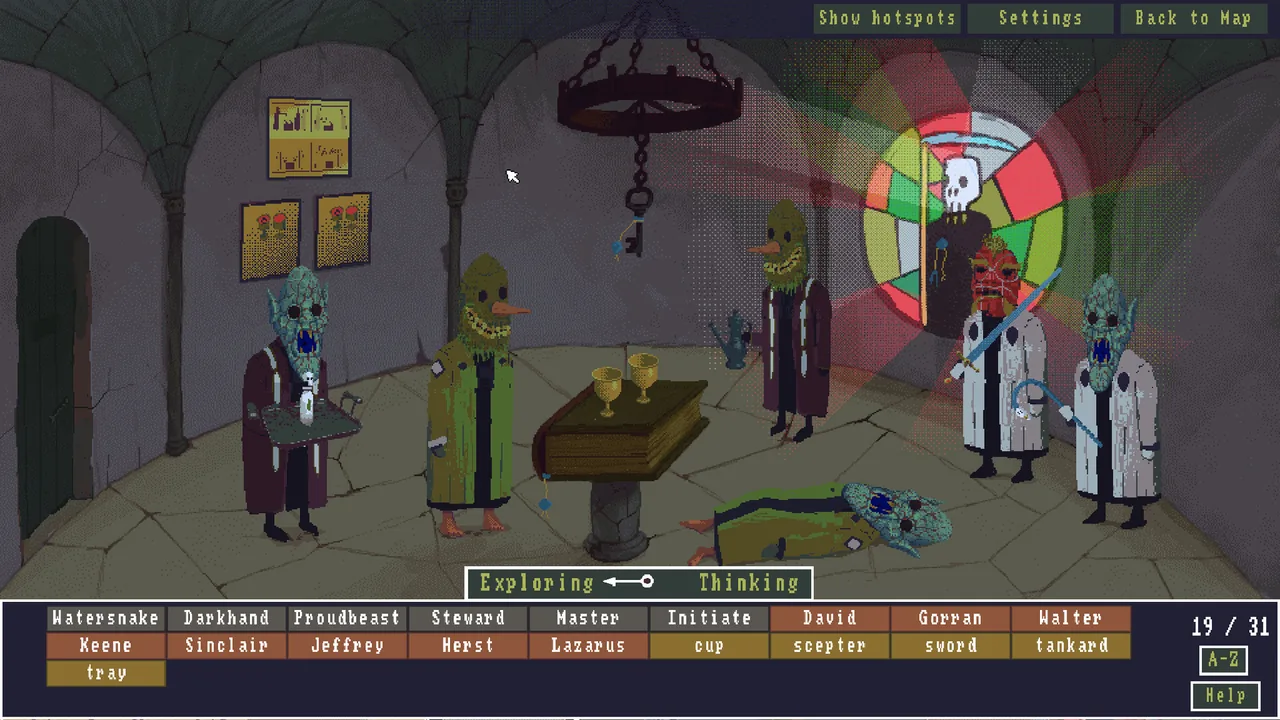
In Exploring, you can inspect bystanders' belongings and offhand remarks. They can reveal words for the blanks in Thinking, along with relationships the body alone cannot explain.
Small answers unlock the case
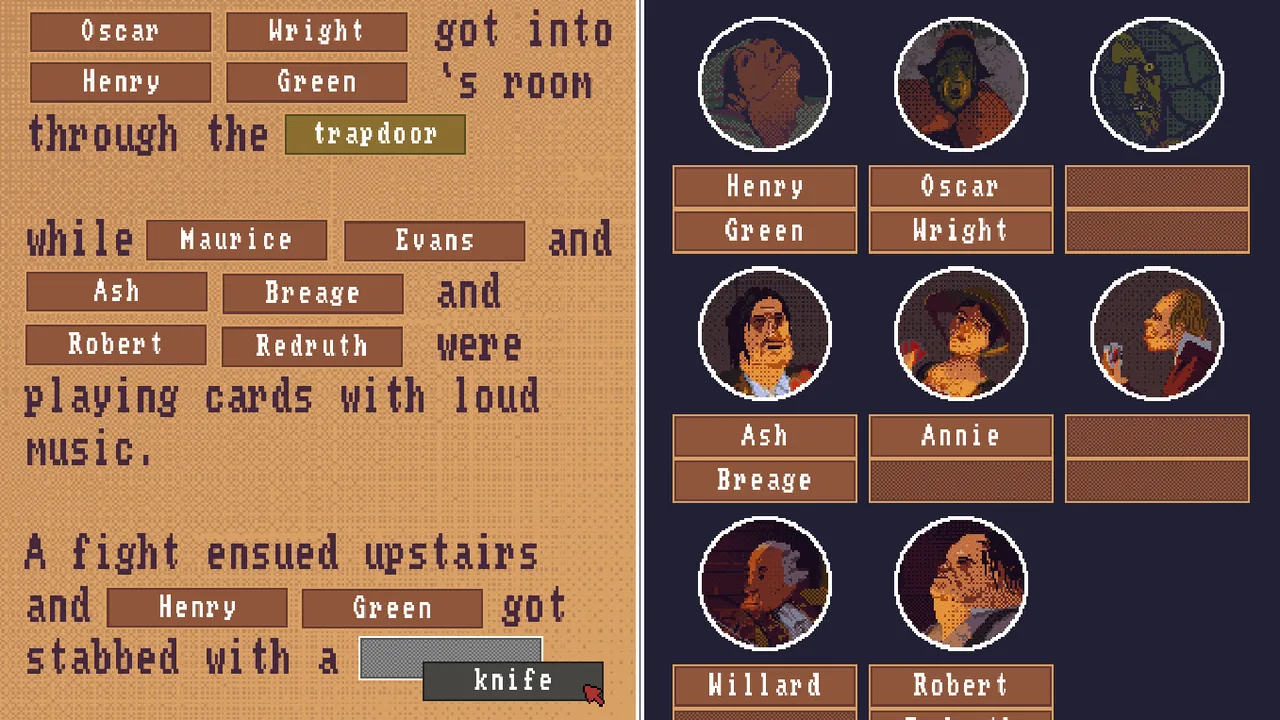
Filling in identities and smaller events in Thinking gives you clues for the main account. You use words collected at the scene to piece together who did what.
Familiar faces recast earlier cases
Recognizing a face or name in a later case can cast an earlier action in a new light. As you solve the cases, you also piece together the story surrounding the Golden Idol.
Game details
As of Oct 29, 2026- Steam Deck
- Verified
- Release date
- Oct 13, 2022
- Developer
- Color Gray Games
- Languages
- Japanese, English (Full audio), Korean / 12 languages total

A typical run
Opening a case reveals a scene frozen around the moment of death.
You inspect possessions, letters, dialogue, and nearby objects to collect names and words for objects and actions.
On the Thinking screen, those words fill blanks about identities and smaller events.
Completing the smaller sections gives you a foothold in the main account of who did what and why the death occurred.
After solving a case, you carry what you learned about recurring characters and the Golden Idol into the next scene.

Core systems
Exploring
This view lets you inspect a scene frozen around a death. Expressions, possessions, documents, and the layout of separate rooms can serve as evidence.
You can move on after examining the victim or read a minor character's possessions and offhand remarks. A word needed for a later blank may be easy to overlook.
Thinking
Here, collected words fill statements about identities and the course of a case. Identity tables and smaller events sit alongside the main account.
You can start by guessing the main account or establish the supporting sections first. Testing words may clear a section, but working out why they fit helps you recognize relationships in later cases.
Collected words
Names and words for objects and actions found at the scene become candidates on the Thinking screen. Related clues may be far apart.
You can search for a word needed by the current blank or inspect the whole scene first. First and last names can be separate clues, making the match between a face and a full name part of the puzzle.
Hints
Guidance is available when you get stuck. Redux revised the hint system.
A hint can help you choose which question to revisit before looking up an answer. You can also leave it unused and reread the dialogue and possessions yourself.
Interactable object markers
Redux adds markers for objects you can examine. They cut down the time spent searching the artwork for places to click.
With markers on, you can spend more time connecting evidence after gathering words. Leave them off if you enjoy spotting suspicious details in the scene yourself.
Redux
Redux revises the interface, hints, readability, saving, and language support. Steam lets you choose it or the original version at launch.
Choose Redux for official Japanese or Korean support. Switching versions also changes the interface and translation, so a clue you have already read may need another look.
What sets it apart
You cannot alter a scene or pursue a culprit. You infer what happened before the frozen moment from the image and written evidence.
Each case has its own solution, yet a face, name, role, or detail about the Golden Idol can mean something different later.
Redux markers reduce the time spent finding objects you can inspect. That leaves more time to work out how the collected words connect.
Learning curve and difficulty
Early cases link identities to immediate causes of death. Later ones ask you to combine information from separate rooms with earlier cases and the characters' competing motives.
Quick controls do little for you here. Matching names to faces and remembering a conflict between a statement and a possession changes how you read later blanks.
Close-answer feedback helps check a theory. It can also be used to test candidates in sequence.
After an answer is accepted, returning to the evidence to explain each word makes recurring characters and late revelations easier to follow.
Reviews describe the expansions as starting near the difficulty of the later base-game cases. Notes on relationships established earlier become useful.
Builds and playstyles
Supporting sections first
Fill the identity tables and smaller events before tackling the main account. The relationships established there give you a basis for its larger statement.
Persistent character ledger
Record faces, full names, roles, and possessions by case. That helps connect a returning character to an earlier case after time has passed or their appearance has changed.
Contradiction elimination
Remove candidates that conflict with a location, statement, or possession. Use close-answer feedback to check the theory left standing.
What longtime players say
Reviews from people who continued into the expansions describe recognizing recurring faces and names through earlier cases. Taking notes helped them keep those details in view.
Players who finished the base game and expansions value being able to return to the scene, reread the evidence, and arrive at an answer they can explain.
Players who reached the expansions describe the challenge as rising from the later base-game cases. What earlier cases established remains useful.
What players like
Cases that first appear separate connect through returning characters and the Golden Idol. A later scene can change how an earlier clue reads, giving players a reason to revisit it.
Reviewers describe the satisfaction of rereading a scene until the words in a completed statement line up with its evidence. Finding the overlooked clue themselves is part of the appeal.
Markers can point you back to an overlooked object, while hints offer a way forward when the deduction stalls. Reviewers appreciate choosing when to use that help.
The cases move from identifying people to sorting out denser relationships later on. Reviewers describe getting unstuck by rereading a dismissed line or questioning an assumption.
The distorted portraits and music written for each scene suit the story's mood. Reviewers who initially found the artwork off-putting describe warming to it.
Players of the expansions like how events before the base game connect and fill in the Golden Idol's story. They describe the challenge as continuing from the later cases.
Common complaints
Reviews of Japanese, Korean, and Chinese text point to awkward lines, swapped names, and translations at odds with the required answer. Since wording is evidence, these problems have interrupted deductions in later cases and expansions.
Reviewers who found the base game short question the cost of adding the expansions. Knowing the answers also makes the original process of piecing clues together hard to repeat.
Later cases send you back to names, earlier faces, and documents scattered around a scene. Without a freeform in-game notebook, reviewers have kept their character notes elsewhere.
The word pool and close-answer feedback can let you test entries without following the full chain of evidence. Similar words and split first and last names can turn a deduction into checking combinations.

Who it’s for
It suits players who like moving between small visual details and short documents until they can explain why each word belongs in a statement.
It also fits those who enjoy solving distinct cases while keeping faces and roles in mind for their return later.
If searching for clickable objects is a chore, Redux markers and hints can help you get back to the deduction.
Who might not enjoy it
It may frustrate players who need a freeform in-game notebook for later character relationships or dislike identifying a returning person again in each case.
Players who need every word of a translation to serve as exact evidence should consider the reported problems with Japanese and Korean text.

FAQ
- Is Japanese supported?
- Steam lists a Japanese interface and subtitles. Select Redux at launch to play in Japanese. Reviews report translation errors that can affect deductions.
- Is Simplified Chinese supported?
- Simplified Chinese is absent from Steam's official language list. Traditional Chinese is listed.
- Does it have cooperative play?
- Steam lists single-player among its features and does not list cooperative play.
- Can the difficulty be adjusted?
- Redux includes hints and interactable object markers. The official update announcements do not describe selectable difficulty tiers.
- Do the expansions connect to the base game?
- Golden Idol Mysteries: The Spider of Lanka covers events before the base game. Golden Idol Mysteries: The Lemurian Vampire connects that story to it. Both require the base game on Steam.
These impressions are based on 100 Steam reviews sorted by “Most Helpful.” They do not represent the views of all buyers.

Image: The Case of the Golden Idol on Steam